An AI digital mascot is a character whose creation or visual production uses artificial intelligence. It can appear in images, on social media and in films, representing the brand through its own appearance and personality.
The challenge arises when the character needs to move beyond the first image and appear in other materials. Its face, proportions and way of expressing itself need to remain recognizable, even when its pose, clothing or surroundings change. This continuity should guide the choice between AI, 3D and hybrid techniques.
For brands and agencies, understanding these differences helps define the project: what to create, how to produce it and which materials will be needed to use the mascot throughout campaigns.


What makes a mascot represent a brand?
A character can introduce a product, explain a service, lead a story or be part of a company's everyday communications. Its role needs to be clear before visual development begins, because it influences the design, the way it communicates and the situations in which it will appear.
A mascot that explains technical subjects may need clear gestures and restrained expressions. Another, created for a humorous campaign, may use more exaggerated movements and reactions. The style should work for the audience and the message, rather than relying solely on a visual trend.
The personality also needs to be consistent. It is worth defining how the character speaks, what it expresses, which behaviors fit the brand and which situations should be avoided. These decisions give the team a basis for approving new materials.
This continuity is related to building recognition. Ipsos highlights the consistent, combined use of distinctive assets, such as characters, colors and sound elements, to strengthen their association with the brand. This does not mean that creating a mascot alone guarantees engagement or sales: its use needs to make sense within the brand's communications.
AI, 3D or hybrid production: which approach should you choose?
The technique should match the intended use. An image for a campaign, a set of poses and a character starring in several films have different requirements for control, continuity and finishing.
Generative AI: references, variations and review
AI can play a role in exploring visual alternatives and producing images and sequences. Depending on the tool and the project, approved references help guide new poses, environments and compositions.
These resources expand the possibilities, but each result needs to be evaluated. Runway's own reference documentation describes iterative processes and acknowledges that new variables can introduce differences between results. A reference is a means of control; visual approval remains part of the work.
In practice, it is worth testing the character in the campaign's most important situations before producing all the materials. A simple pose may work well, while an interaction with a product or a change of angle may require a different approach.
3D: a character built for new applications
In 3D production, the character can be developed as a model with geometry, materials and, when necessary, controls for poses and animation. This structure makes it possible to work on new framing and movements from the same base.
Rigging is the preparation of the controls used to move the character. One way to understand this stage is to think of a digital skeleton: in the Blender manual, armatures are described as bone structures that can be posed for static or animated scenes.
Not every project needs the same level of preparation. A set of images and an animation with facial acting may require different scopes of work. It is also important to distinguish an image with a three-dimensional appearance from an editable 3D model: the image's style does not determine which files exist or will be delivered.
Hybrid production: speed, creative freedom and cost savings
Generative AI can speed up the creation of images and animations and expand the freedom to explore poses, movements and settings. In image-to-video workflows, it is possible to animate a character from a reference without building a conventional rig, the structure of controls used in many 3D animation processes.
This possibility makes it easier to test visual approaches and put ideas in motion without preparing every character control in advance. By reducing the preparation needed at certain stages, AI can also reduce costs. Exploring alternatives for performance, environment and composition can become faster and more economical, depending on the requirements of each piece.
The result of each generation needs careful attention. The face, proportions, accessories and interactions with products need to be reviewed throughout the scene. AI's freedom comes with decisions about selection and finishing; when the project requires an exact gesture or very specific continuity, these requirements should guide the tests and the chosen technique.
AI increases scale, speed and autonomy in production, while creative vision, direction and judgment continue to guide the choices. Hybrid production combines these possibilities with other resources as needed. A project can use AI to explore scenes and movements, 3D for elements that need specific control and compositing to bring everything together. It can also start with a character developed in 3D and use images of that model as references for an AI animation.
The combination does not need to be the same for every piece. What matters is deciding where the freedom of generation helps and where it is worth keeping more defined controls, aligning appearance, lighting and movement so that the character remains recognizable.
| Approach | What it offers | What to consider |
|---|---|---|
| Generative AI | Speed, freedom to explore variations and the possibility of reducing costs in creation and animation stages. Allows animation from references without a conventional rig. | Review identity and continuity between generations, select the results and refine the finishing. The number of attempts and the level of refinement influence the final cost. |
| 3D | An editable base for working on framing, materials and animation with controls defined according to the project. | Prepare the model and, when necessary, the rig before animation. This preparation can be reused in new applications. |
| Hybrid production | A combination of AI's speed, freedom and potential cost savings with the control offered by other techniques at the stages where it is needed. | Plan the integration of the elements and maintain visual consistency across the different production stages. |
Cost savings depend on where AI is used in the project. Reducing the preparation for a scene can reduce the work at that stage, but additional attempts and finishing also need to be factored in. The comparison should consider the same scope and expected quality, without treating a fixed percentage as a rule for all projects. At MUVA, we create digital mascots and characters for agencies and brands with AI, 3D or hybrid techniques, according to each project's needs.
How to maintain the mascot's identity across different images and videos
Consistency begins with clear visual decisions. Before expanding the applications, it is important to establish which characteristics identify the character and which can change without compromising its identity.
Face shape, silhouette, proportions, colors and accessories can form this identity. Campaign clothing or a specific expression, on the other hand, can vary, as long as this flexibility is planned for. Recording these choices prevents each new image from being approved according to different criteria.
A set of references can bring together approved views, poses and expressions. The goal is to allow the creative, production and approval teams to compare the result against the same character, rather than relying only on their memory of the first version.
In AI projects, this set can guide reference-based generation or the adaptation of a model. One of the available techniques is LoRA, which makes it possible to adapt a model by training a smaller set of parameters, as explained in the Hugging Face documentation. Its use depends on the chosen workflow; not every mascot needs dedicated training.
The set of images used also needs to be consistent. If the references already show different faces or proportions, it becomes harder to establish which version should guide production. Selecting, organizing and validating the material are just as important as the technique used.
In videos, the review needs to follow the movement. A character may start a scene correctly and change during an action. For this reason, in addition to the appearance of each frame, it is necessary to observe the continuity of the performance and the relationship with the other elements in the scene.
- Do the face, silhouette and proportions remain recognizable?
- Have the important colors and accessories been preserved?
- Do the expressions and gestures fit the defined personality?
- Does the interaction with products and objects work throughout the action?
- Are there deformations or changes in appearance between scenes?
- Does the composition maintain space and legibility for the campaign elements?
These tests help identify when to adjust a generation, redo a scene, work on the finishing or reconsider the technique. Production should allow for this evaluation, especially when the character will appear regularly.
From idea to materials: what needs to be defined at each stage
A project begins with the context of use. The audience, communication objective, channels and existing materials form the brief. If the brand already has a character, its references and usage guidelines are also included at this stage.
Visual direction turns this context into choices about appearance and personality. This is the time to evaluate alternatives and approve a base before moving on to many poses or scenes. Structural changes become harder to manage when several materials are already in production.
With this base defined, application tests show how the mascot works in the planned situations. A close-up, a full-body pose and an interaction with a product can reveal needs that do not appear in the presentation image.
Production of the materials follows the approved scope, with reviews of identity, movement, composition and finishing. At delivery, formats, resolutions, versions and any production files need to match what was agreed. If there is an intention to create new campaigns, this continuity should be discussed from the start.
Sabesp characters: an application by MUVA
In this animated GIF from a MUVA project for Sabesp, different characters alternate against a gray background. Each has its own visual characteristics, an important aspect when the communication involves a group of characters.
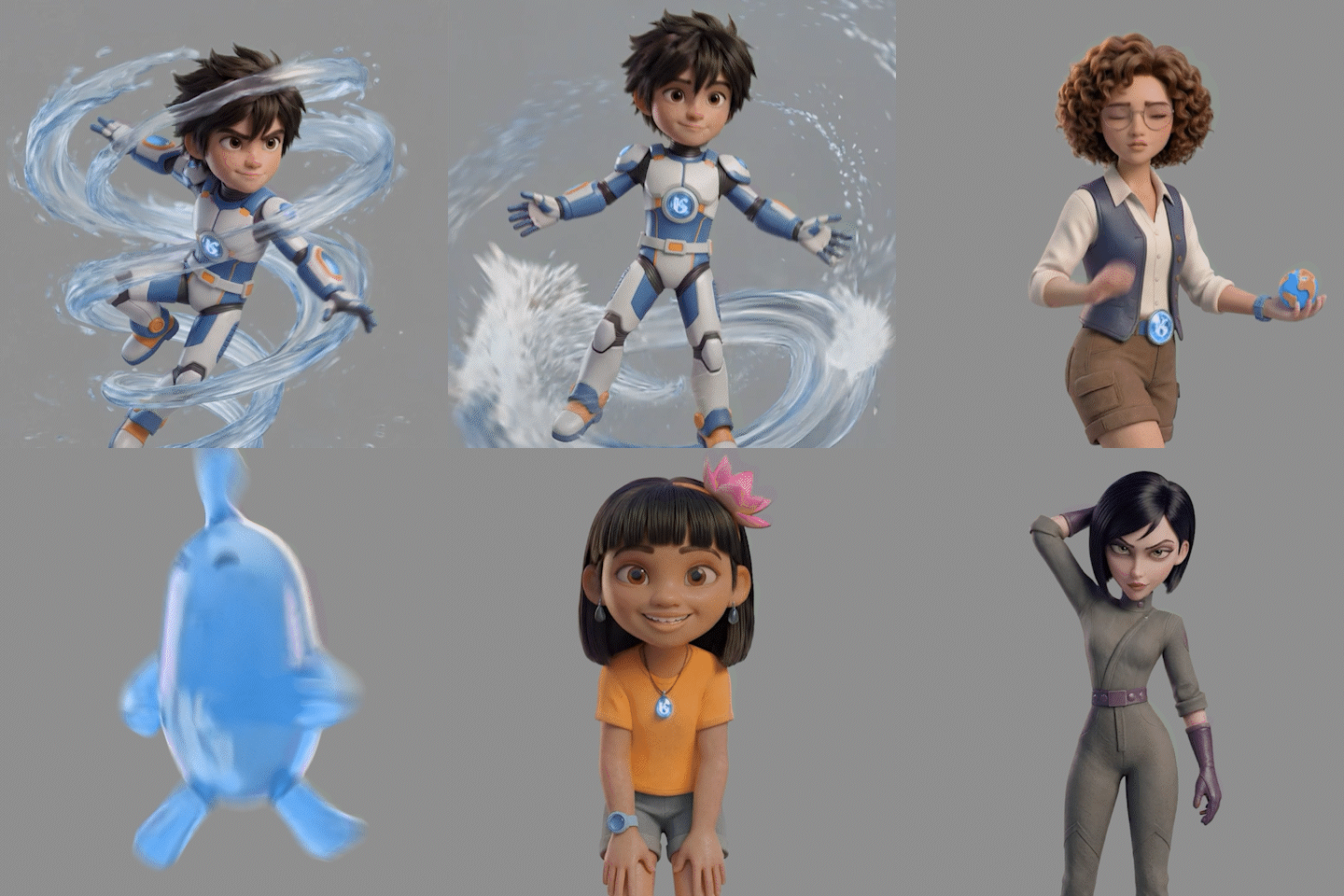
When a campaign involves several characters, the brief also needs to clarify each one's role and the situations in which they appear together. This definition helps determine the references, scenes and materials needed for production.
What influences the cost of a digital mascot?
The cost depends on what will be developed and how the character will be used. Creating a mascot from scratch, adapting an existing character and producing new materials from an approved base involve different kinds of work.
The number of characters, visual complexity, poses, expressions, scenes and animation requirements help determine the scale of production. Delivery formats, revisions and the need for editable files also need to be clear. The use of AI alone does not establish a fixed cost saving: testing, selection and finishing are part of the scope.
To request a proposal, gather the information you already have:
- Objective: what message or function should the character take on?
- Starting point: will this be a new character, or do a design, model and guidelines already exist?
- Applications: will these be images, poses, films or a combination of formats?
- Quantity: how many characters and which situations need to be produced?
- Channels: where will the materials run and which versions will be needed?
- Approval: who takes part in the decisions and which stages need to be validated?
- Continuity: are new campaigns planned, or is there a need for production files?
It is also worth agreeing on the conditions for using the materials and the rights involved. The proposal should make clear what is included, which files will be delivered and how future adaptations may be handled.
Frequently asked questions about AI digital mascots
Do I need a 3D model to create a digital mascot?
Not necessarily. A mascot can be produced for images and videos without the delivery including a 3D model. The need for this asset depends on the applications, the desired control and how the character will be reused.
Is it possible to start with a character the brand already uses?
An existing character can serve as a starting point. Before defining the production approach, it is necessary to evaluate the references, available files, guidelines and conditions of use. Adapting it for new applications may require additional development.
Does AI keep the mascot identical in every scene?
There is no automatic guarantee. References and adaptation techniques help guide the results, but new images and movements need to be reviewed. The level of control required by the campaign may point to production using AI, 3D or a combination of techniques.
Does every project need a dataset and LoRA?
No. A dataset is an organized collection of data, which can include images of the character; LoRA is a model adaptation technique. These are possible resources, but the choice should take into account the tests, tools and project needs.
Does the quote include a model, rig and editable files?
This needs to be defined in the proposal. The delivery of images or films does not, in itself, imply the delivery of a 3D model, rig or other production files. If the team intends to reuse these materials, it is worth stating this need in the brief.
Does a mascot created with AI also talk to the audience?
Visual creation does not automatically include a customer service function. For the character to respond in real time, a specific interaction project is needed, with its own technology, content and operating rules.
Shall we develop your brand's character?
At MUVA, we create custom mascots and characters for agencies and brands, with applications on social media, in images and in films. Explore our digital mascots and characters service and talk to our team about the project. If you already have references or an existing character, send these materials along with the applications you intend to produce.